
Myra Jane
A musician finds his voice at a terrible price

What would you do for the music you were born to make? When a pawnshop guitar gives Johnny everything, he has to choose whether his survival is worth another’s ruin. A sharp, unnerving tale about talent, ownership, and the cost of arrival.
The take ended. Johnny lifted his pick from the strings and sat in the silence that followed.
He played it back.
The interface’s tiny speaker reproduced what the room heard thirty seconds ago, the progression he’d been working since noon, the descending run he almost had, the chord that landed a quarter-step flat of where it lived in his head. He listened to all of it with his eyes on the acoustic foam tacked to the far wall, the kind of foam he’d bought in a hardware store and mounted with push pins because actual studio foam cost money he didn’t have, and he listened the way a surgeon listens to a patient breathing: alert for the specific sound of a thing that has gone wrong.
It was there. It was always there.
It wasn’t technical failure. Nothing so clean as that. The notes were right. The rhythm was right. What was wrong lived somewhere underneath all of that, in a gap between what he heard in his head before his fingers moved and what actually came out of the interface. The sound he imagined had weight to it, a quality that could not be argued with. The sound in the playback was competent and polite and utterly without that quality.
He stopped the recording. Opened the blue spiral notebook on the desk beside him and found a blank line.
Tuesday. 11:14pm. Dm7, open position: index across the first fret B and high E strings, middle finger second fret G string, D string open. A room with foam on one wall and carpet that is not helping. I was thinking about whether it mattered. It didn’t sound like it mattered.
He closed the notebook. Four hundred and twelve entries, give or take. He’d never counted exactly.
The YouTube tab was still open in the browser behind his DAW, minimized. He did not need to open it to know what was there: a channel with eight hundred and forty-seven subscribers, the latest video sitting at two hundred and sixty-three views after five days, the comments a small garden of encouragement from people who were being kind rather than compelled. Great tone! one of them wrote. Keep it up! The exclamation points were the tell, the language of someone whose threshold for enthusiasm was not very high, or who was cheering for the effort rather than the result.
He knew the difference. He always knew the difference.
A key in the lock. The front door.
Beth came through with a paper bag from the Thai place on Western, the one with the hand-painted fish above the register. She set it on the kitchen counter without taking her coat off first, which meant she walked faster than the weather called for, which meant she was working through a thought and hadn’t finished.
“You eat today?” She pulled cardboard containers from the bag.
“Yeah.” He didn’t, exactly. Coffee and a protein bar counted as a thing that had happened.
The look she gave him over her shoulder was not a challenge. It was accurate.
They ate on the couch because the table had his gear on it, the interface and the hard drive and three cables he kept meaning to organize. Beth had her shoes off. The television was on low, a nature documentary, blue water filling the screen, and neither of them were watching it. This was one of the things he liked about her. The silence between them had no friction in it, no sense that anything had gone wrong.
She was telling him about a piece of furniture she found at an estate sale that weekend, a dresser with the original hardware still intact, the little backplate behind each pull shaped like a crescent moon. She was going to strip the paint and get back to whatever was underneath it.
“You ever think something’s been buried under there so long it doesn’t know what it used to be anymore?” She was folding her empty noodle container in half. “Like the wood just forgot.”
“I think about that.” He meant it. That was exactly the thing he meant.
She looked at him the way she sometimes did, briefly, with an attention she reserved for moments when he surprised her. Not that he surprised her often. They were together long enough that the edges were known. But occasionally he said a thing that still caught her.
“You always catch yourself.” She turned back to the documentary, a wide shot of open water. “You’ll say something and then you go quiet, just for a second, and I can tell you’re checking whether you actually meant it.” She set the container on the cushion beside her. “I don’t think you even know you do it. It’s one of my favorite things about you.”
He half-smiled. Let it pass. They stayed on the couch until the documentary ended and then they went to bed.
Saturday. Cold and gray, March with no interest in becoming April.
Johnny walked because he needed to walk. The bedroom started to feel like a waiting room, same foam, same chair, same forty-seven seconds of playback with the gap still in it. He had no destination. He had the restlessness of someone who has been in one place too long and doesn’t know whether moving will help or just change the scenery.
He walked past the pawn shop before. He could not have said exactly how many times.
It was wedged between a dry cleaner and an insurance office on a block losing ground to parking lots for a decade. The window was crowded the way pawn shop windows always are: a saxophone case standing open, two acoustic guitars hanging at angles, a trumpet, three mismatched speakers, an amp with a water stain on the cabinet. The accumulated inventory of other people’s abandoned intentions.
He went in.
The smell hit first: old carpet and metal, faintly electrical. The light was wrong in a way he couldn’t immediately locate, not dim exactly, just the wrong color, as though the bulbs were slightly off the spectrum of ordinary light. Objects in the cases looked more significant than they had any reason to be. He moved through the aisle between the glass countertops, past a rack of cables and effect pedals, past a digital piano with a film of dust on the keys.
The man behind the counter was watching him the way a person watches traffic, steady and without interest, a gaze with no off switch. Thick through the shoulders and gone soft through the middle, gray stubble suggesting he’d stopped thinking about it rather than stopped caring. A flannel shirt with a breast pocket. He didn’t speak, and the reading glasses in that pocket stayed where they were.
Johnny moved toward the back of the shop.
The wall held a row of electrics on hooks, a couple of Strats, a Les Paul copy, an unbranded guitar with a sunburst finish that started to crack at the edges. He was looking at them without really looking, the way you scan things when you’re waiting for one to stop you.
He saw the red before he registered what he was seeing.
A sliver of it, just visible around the edge of a standing rack of acoustic guitars near the back wall. Arterial. Deep. He moved the acoustics aside on the rack, gently, and she came into full view.
He stood there for a moment before he touched her.
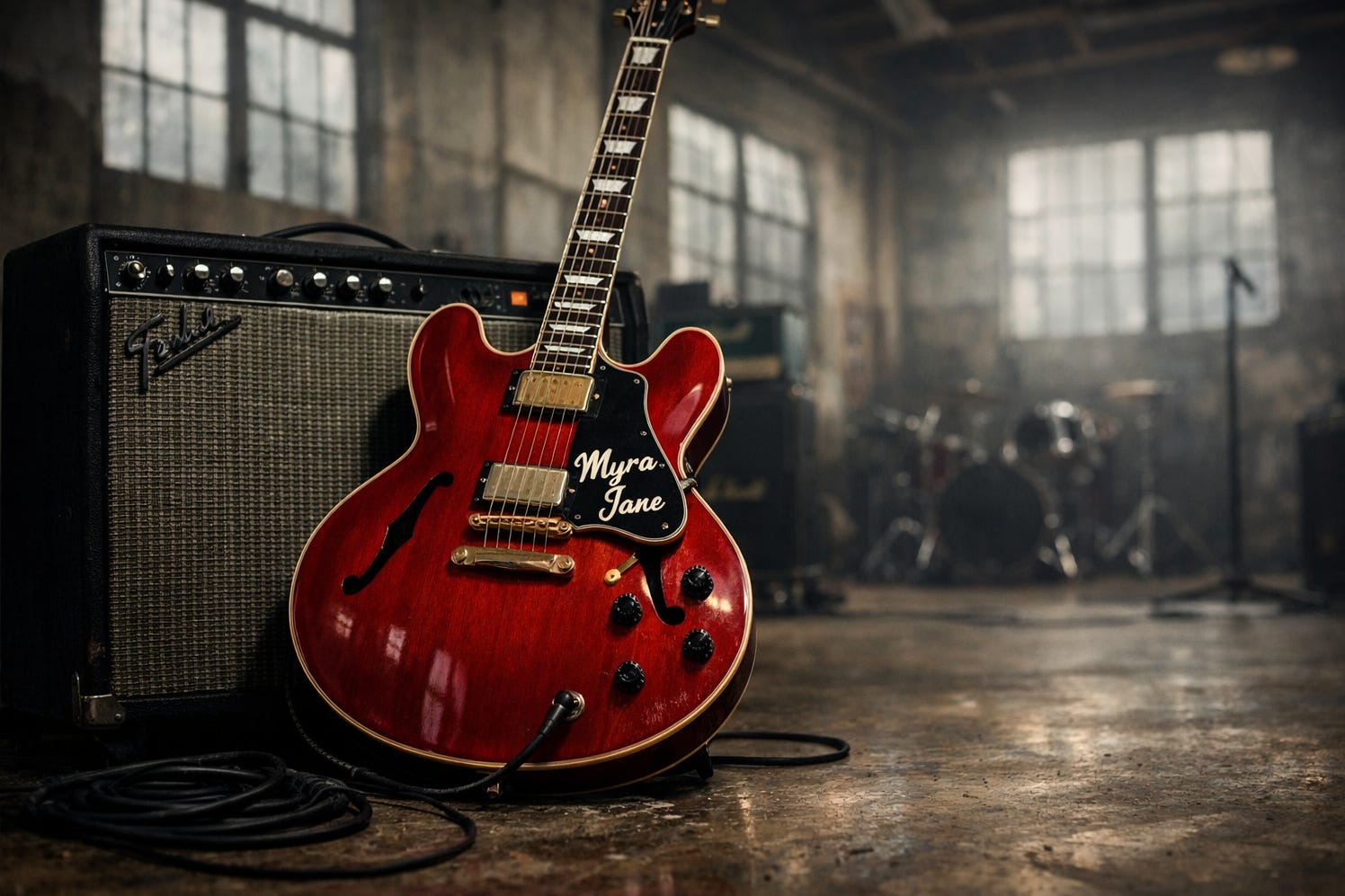
A Gibson ES-355, semi-hollow, thinline body, the double cutaway clean and precise as a geometry proof. Gold hardware untarnished despite what must have been years, maybe decades, of hands and air. An ebony fretboard with block inlays so large they looked architectural. The split-diamond headstock rising above all of it with a formality that was incongruous with a pawn shop shelf. The finish was neither glossy in the aggressive manner of a new instrument nor worn in the matte manner of a genuinely old one. Somewhere between the two, and that somewhere was the wrong word. She looked patient. That was the only word that fit.
He almost missed it. Low on the pickguard, painted in a careful cursive that faded to the color of old ivory against the black: Myra Jane.
He picked her up without asking the price.
His fingers found a chord shape without his deciding on one, a D minor seventh, not so different from what he was working on for three days in the bedroom, but the sound that came out of the body was not even in the same conversation. The acoustic resonance of the chambered wood. The warmth of the neck under his thumb. The strings responded like they were waiting to be held correctly.
“You want to plug her in.”
The shop owner appeared at the end of the aisle. He might have been there all along.
A small blackface amp sat against the wall, already on. Johnny plugged in with the cable looped over the amp’s handle. He played the same chord. The sound filled the shop and then kept filling it for a moment longer than it should have, a warmth that seemed disproportionate to the wattage.
He played a progression. Then another. He lost track of whether he was deciding what to play.
“She’s been here a while,” the shop owner said. “People look at her. Most put her back.”
He paused, and in that pause a shift moved through his affect, away from the transactional and into a different register entirely. The tone of a man who is not trying to sell anything because the thing will sell itself, and who has information the buyer did not know to ask for, and who has shared it before, in this shop, to other people who stood where Johnny was standing now.
“She’ll make you play like God himself is moving your fingers.” His voice did not change in pitch or speed. “Better than sex, better than anything. And after she’s fucked you, your ass will be hers.”
The phrase sat in the air between them like an object.
Johnny’s internal response was immediate and specific: recoil. Distaste, not fear. The vulgarity was not the problem; the problem was the complete absence of distance between what the man meant and what he said, the way the words came out with the flatness of a thing observed rather than felt. No one Johnny ever respected talked like that. No one he ever respected would have said a thing like that and then gone quiet and waited to see what happened next.
His hands were still on the guitar.
He could feel the chord shape under his fingers from three minutes ago, the way the neck fit differently than any neck he held before.
He paid. He did not negotiate.
On the drive home he kept thinking about the name on the pickguard. Myra Jane. He had not given it to her. It was already there.
That night, he sat in the bedroom with the acoustic foam on the wall and the interface lit up blue on the desk. He plugged in. He pressed record.
What came out of him in the next four minutes was not a song he wrote. Not a fragment he was developing. Not a mood he was chasing, or a technical exercise that got out of hand. It was complete, structured with a coherence that had a logic he could hear but could not explain, like finding a fully built room behind a wall you’ve been living next to for years. It had the quality he reached for. The quality you cannot describe except by saying: this cannot be argued with.
He played it back.
The gap was gone.
He sat for a long time in the chair, the laptop’s light mixing with the blue glow of the interface, Myra Jane leaning against the desk beside him. He opened the blue spiral notebook and held his pen over the blank line.
He closed the notebook.
He did not know what he would write.
Three weeks after Myra Jane came home, Johnny recorded a chord progression he never consciously developed.
He noticed it the way you notice a word you’ve been mispronouncing: in retrospect, with the dim recognition that it was happening for some time before the noticing. He was at the interface at ten in the morning, coffee going cold beside the keyboard, playing back a take from the night before. In bar five there was a progression he did not remember deciding on. Not an accident. The voice leading was too deliberate for an accident, but he couldn’t trace it to any exercise he was working through, any fragment he was turning over. Just: there. He told himself it was the product of sleep-deprived automaticity, the hand executing what the mind was processing below the surface. Musicians talked about that. He told himself it was that.
A week later, a melody arrived in his hands before it arrived in his head. He was mid-take, not thinking, and his fingers moved to a phrase that he only recognized as music a beat after it was already playing. He stopped the take. Rewound. Listened to the phrase. It was good, better than good, it had the quality that eluded three years of bedroom recordings: the quality that could not be argued with. He did not remember hearing it first.
He told himself the order didn’t matter.
Two in the morning, eleven days after that: a song completed itself in a single take and he could not remember the middle section. Not right away. Right away he felt only the completion, the satisfaction of a thing that arrived whole. He sat in the chair in the blue light of the interface and played it back and listened to the middle section and understood that his hands did it, that the sound was the sound of him playing. He could not locate the experience of having played it. He was there. He was not there.
Flow state, he told himself. Finally loosening up.
He posted the take the next morning with no description beyond the date and Myra Jane’s name in the caption. Within twelve hours the views were climbing with an energy unlike the polite accumulation of before, a momentum feeding itself with no precedent on his channel. He sat at the laptop and watched the counter and tried to decide how he felt about it. The comments were not the comments he was used to. These were personal, attached, slightly urgent. People were not discovering a musician; they were recognizing one. He read them with growing disbelief that shaded, inside a week, into conviction. He was right. There was real depth in him. It just needed the right instrument.
The name appeared for the first time in a comment on the fourth video. He mentioned Myra Jane in a description, casually, and one viewer latched onto it immediately: Is that guitar Myra Jane? There’s something about Myra Jane. Within two weeks it was circulating without prompting. Comments began asking about her specifically, where she came from and what she was and whether she was for sale. He posted a photo. The comments that followed were disproportionate to the image, personal beyond what the imaged warranted. He found this charming. He found it accurate.
He canceled plans with Beth for the first time on a Wednesday. He was mid-take and called out from the bedroom that he couldn’t, sorry, he needed to finish this. He heard her pause in the doorway and did not turn around.
The second time, she arrived to find him at the laptop and he said yes to whatever she suggested without fully tracking the question, and when she said his name twenty minutes later he looked up with the expression of someone returning from a great distance. She stood in the doorway already wearing her coat.
“We said dinner.”
“Right.” He looked at the screen. He looked at her. “Can we do tomorrow?”
She didn’t answer. The pause was the answer but he did not read it.
He surfaced from the bedroom at two in the morning on a Tuesday with the look of a man who was somewhere she could not follow. Not altered, just elsewhere, complete and satisfied, none of it connected to her. She was awake, reading, and she watched him come into the kitchen and fill a glass of water. He told her about the take in the manner of someone sharing good news that has no room for the listener. The progression in the bridge, how it came out of nowhere, how it was the best thing he put on tape. She said that was great. Going back to the bedroom, he paused in the doorway to say he knew.
She kept reading for a while after that. Then she turned out the light.
The weeks that accumulated around these moments had a quality she could not name. It was not distance, exactly. Distance implies a gap with two sides, and what she felt was that only one side remained. He was not unkind. He was not cold. He answered when she spoke, made coffee on the mornings he remembered, asked about the dresser she was stripping in the spare bedroom with what sounded like genuine interest. The problem was in the lag: a half-beat delay between when she said a thing and when it reached him, as though her words had to travel through a different medium to arrive and came out slightly changed by the passage. She would speak and he would look up from wherever he was and respond, correctly, appropriately, and she would understand that she was addressed and not reached.
She kept this to herself for a while. Then she didn’t.
One evening she came and sat across from him at the table where he was editing audio and waited until he looked up. When he did, she said, in the direct warm way that was hers, that lately she felt like she was talking to a recording of him. That the person who answered when she spoke was not quite the person she was speaking to.
He heard it as concern. The concern of someone who loved the struggling version of him and couldn’t quite expand to contain the version that was no longer struggling. He reached across the table and put his hand over hers and said that he understood, that it had been a lot, that things would level out. He was gentle about it. Even affectionate.
He did not understand that he was leaving.
Her face in that moment was readable to anyone paying attention from outside the conversation. She was not making an argument. She was not asking him to change. She was recording the fact of what was, with the stillness of someone who has already arrived at a conclusion and is taking the last measurement before closing the notebook.
She took her hand back, said okay, and went to bed.
She told him on a Tuesday morning, standing in the kitchen with her coffee going cold on the counter behind her. She did not rehearse it, or if she did, it didn’t show. She said she could not keep building toward a future with someone who had stopped building. She said it without anger, because anger would have required her to believe he chose this, and she was not sure he had.
She was not crying. She was done.
She took the first load in two trips from the spare bedroom: the dresser she was refinishing and all the tools for it, the drop cloths, the crescent moon hardware in a zip bag. Johnny stood in the kitchen doorway and watched her and said he was sorry and meant it in the general way of someone who does not know precisely what they are sorry for. She moved past him without stopping. At the front door she set the bag down to get a better grip on the dresser and he came forward to help and she said she had it. She did.
Between her first and second trip, he went into the bedroom.
He did not decide to pick up Myra Jane. She was in his hands before he decided anything, and then he was playing, and then the music was moving through him in the way it moved now, fully formed and requiring nothing from him except to stay out of its way. He sat on the edge of the bed facing the window. Outside, a gray afternoon. Inside, the sound filling the room the way it always filled the room now, deep and complete, leaving no space for anything else.
He played for two hours.
When Beth came back for the second load, he was still playing.
She moved through the apartment with the quiet efficiency of someone who had already completed the hard part. He could hear her through the music, distantly, the sounds arriving in the spaces between notes: the spare bedroom door, the soft compression of her footsteps crossing the living room floor, a drawer she opened and closed. He was aware of her the way you are aware of weather happening on the other side of glass. He did not stop. The take was going somewhere and he was not willing to lose the thread of it.
The front door opened.
He did not stop.
The door closed quietly, with the specific care of someone who does not want to be heard. Not slammed, not held open for a moment. Just: closed. The sound reached him through the music and registered in him and he kept playing. He played until the take arrived where it was going, and when it did he sat in the silence for a moment and then began the next one.
The spare bedroom was empty when he walked past it an hour later. The refinishing supplies were gone, the drop cloths, the dresser with the crescent moon hardware she found and loved. The room had the specific blankness of a space recently vacated, the ghost of furniture still faintly visible in the carpet. He stood in the doorway for a moment and looked at it and then went back to the bedroom and picked up Myra Jane and played until midnight.
What he felt, in the days that followed, was not grief and not guilt. It was a new quality of the air in the rooms, more space in them than before. The hours Beth occupied were available now. He filled them with recording, and the recordings kept getting better, and the following kept growing, and the name Myra Jane appeared in the comment threads with the frequency of a word that has entered common use. He read the comments the way you read confirmation of a belief you have held for a long time.
Beneath all of this was a thing he did not examine. He picked up the guitar instead.
Twelve days after Beth left, he finished a take at eleven at night that was the best thing he ever recorded. He sat in the blue light of the interface and listened to the playback and knew it with the certainty that requires no argument. Then he opened the blue spiral notebook.
He held his pen over the blank line for ten minutes.
He could not locate the tone. He could not find the thought he was having while playing. He could not locate, anywhere in his recent memory, the experience of making what he was listening to. The playback was his hands, his guitar, his room. The making of it belonged to no one he could find inside himself.
He wrote: No entry. Arrived already made.
He closed the notebook. He did not think about it again.
Six days later, a direct message arrived on the channel from a name he had to search before understanding what it meant: someone affiliated with Black Meridian. The message was brief and casual in the measured way of people who do not need to signal excitement. Certain members of the band were following the channel. They found the recordings interesting. There might be a conversation worth having.
Johnny read it three times. He closed the laptop, then opened it and read it again.
He created a folder, named it Proof, and saved the message inside. He sat for a long time looking at the folder name in the sidebar. What he felt was not surprise. It was the specific satisfaction of a thing confirmed, the recognition of a direction that was real all along and was now seen by the people capable of seeing it. Myra Jane had given him a voice. Now the world was finding him.
He picked up the guitar and played until two in the morning. He did not open the tone log.
The notebook sat on the desk. He had stopped seeing it.
The band’s manager was named Carver, and he talked the way people talk when they have learned that measured enthusiasm is more persuasive than visible excitement. Johnny was on the video call for forty minutes and did not once go quiet to verify he meant what he was saying.
“The recordings have a quality that’s hard to locate technically,” Carver said. “It’s not the production. The production is bedroom-level. It’s something in the playing itself that reads as... I don’t want to say inevitable, but.”
“Inevitable is the word,” Johnny said.
Carver pointed at the camera. “Exactly.”
Afterward, Johnny sat at the desk for a while with the laptop still open. He spoke for forty minutes about his music and his process and his vision for where it was going, and none of it required the pause. The pause Beth named, the half-second check between what he meant and what he said. He did not need it. He thought about what that meant and arrived at the obvious answer: he trusted himself now. The pause was the product of doubt. The doubt was gone.
The tone log sat on the desk beside the laptop, closed. It was closed for six weeks. He did not think about it.
Three days before he was due to drive to the city, he noticed his old guitar in the corner.
It was there since the week Myra Jane arrived, in its case, leaning against the wall behind the door. He could not have said the last time he registered it. He crossed the room and unlatched the case and took the guitar out.
He tuned it. The neck moved in the dry air, the strings stiff, and the tuning took longer than it used to. When it was done he sat on the edge of the bed and set his fingers to a chord shape. Nothing ambitious. Four bars, a simple progression, an honest thing. He wanted to hear himself unaugmented. Just to know.
He played the first bar.
He stopped.
He played it again, the same four chords, and sat with what came back at him through the body of the guitar. The gap was there. His first thought was: still. His second thought arrived a beat later and was different: this is not the same gap.
The old gap was painful. It was also habitable, the distance between what he heard in his head and what his hands could execute, the ordinary condition of a musician working honestly toward something. He never loved it. He understood it. He lived inside it the way you live in a house that is not quite right: aware of every flaw, and staying anyway.
This was not that.
He played the four bars a third time and listened carefully. The sound coming off the strings was clean enough, technically correct. What was missing was not in the notes. It was in the space around the notes, a quality of weight and depth that he now understood never belonged to him in the first place. He was on the other side of the gap for two months. He heard what lived there. Now the ordinary side was unplayable. The distance between what Myra Jane gave him and what he was before was not a gap anymore. It had no floor.
He put the guitar back in the corner. He picked up Myra Jane, and the music returned before his fingers fully settled on the strings, deep and full and requiring nothing from him except to stay out of its way.
He told himself the experiment proved nothing. He was a different player now than he was then. Of course the old measure didn’t fit.
He played until dark.
Black Meridian’s rehearsal space was in a building that once was a factory, the ceilings high and bare, the windows reinforced and tinted so the light inside looked identical at ten in the morning and four in the afternoon. He stood in the doorway when he arrived and felt the room before he stepped into it. It had the density of a place used hard for a long time.
A man named Carl introduced himself as the band’s coordinator, pressed a drink into Johnny’s hand before he had his jacket fully off, and walked him through the space with the easy hospitality of a host who has done this before and is neither performing it nor withholding it. The rehearsal room itself was enormous and dim regardless of the lighting. Cords and cases arranged against the walls. A drum kit assembled at the far end. The faint smell of old amplifiers and rosin and years.
The band arrived in ones and twos over the following thirty minutes, each introduction brief and warm and offering nothing to hold. Then the frontman came through the door.
He was tall. He moved with the deliberate unhurriedness of someone who burned through several versions of himself and kept only what proved load-bearing. He crossed the room and shook Johnny’s hand and looked at him steadily for a moment before speaking.
“The recordings,” he said. “There’s a descending run in the third one you posted. Bar eleven, I think. I’ve listened to it probably fifteen times.”
“The one in B minor.”
“That one.” He released Johnny’s hand. “I wanted to see if it was the room or if it was you.”
He moved away before Johnny could respond. Someone handed Johnny another drink and he stood in the middle of the room and understood, with the clean certainty of a thing felt rather than reasoned, that this was where he was supposed to be. He traveled from a bedroom with foam on one wall to this room, and the distance was enormous, and it was exactly right.
He plugged in.
What came through him in the next three hours arrived the way it always arrived now: fully assembled, requiring only his hands as the point of delivery. The band settled in around the music with the practiced ease of people who have played with many musicians and know quickly what they have. The frontman watched from behind his guitar with an expression that did not change often but changed twice during the session, both times in the direction of approval.
At one point Carl, listening from a chair near the wall, said something to the bassist that Johnny couldn’t hear. The bassist nodded once.
Near the end of the third hour, the frontman stopped between takes and said, “That’s it. That’s what I heard in the recording.”
“Yeah,” Johnny said. He meant it completely. He could feel it: the music landing exactly where it was aimed, every note with the weight behind it that he reached for his whole life.
He drove back to the rental that night certain he arrived. He ate at the window and watched the city lights below and felt that the world finally caught up with what he knew about himself.
In the dark he tried to reconstruct what he played.
He started with the third hour, the run the frontman responded to. He searched for it the way you search for a word you know you know, pressing at the edges of the memory to find a way in. He found the room: the high ceilings, the dim light, the bassist’s nod. He could not find the music. He pressed further back, to the second hour, a progression that surprised him as it came out. Nothing. The first hour. A single chord, somewhere in the opening, something that resonated in the room in a way he couldn’t name. Gone.
He played for three hours. He owned none of it.
He was asleep before he could finish the thought.
The second session with Black Meridian had been running for two hours when it happened.
Johnny was mid-phrase, a long descending run in the upper register, and talking simultaneously in the way musicians talk inside a working groove, the chatter that fills the space between takes without interrupting the forward motion of the session. The frontman said something about the next take and Johnny was responding, his hands continuing independently, and what came out of his mouth was:
“She’ll make you play like God himself is moving your fingers. Better than sex, better than anything. And after she’s fucked you, your ass will be hers.”
His fingers kept moving for one more beat. Then his hands went still.
The silence in the room was brief, two or three seconds, the band registering the phrase with the uncertain stillness of people who aren’t sure whether they heard a joke or a quote or a thing that requires a response. The frontman’s expression didn’t change. Carl looked up from his phone.
Johnny set Myra Jane down on her stand.
“I need a minute.”
He walked out of the rehearsal room into the stairwell and sat down on the steps.
The stairwell was concrete and cold and lit by a single fixture two flights up. He sat on the third step with his elbows on his knees and looked at the floor and did not move for a long time.
The phrase was still in his mouth. He could feel the shape of it, the specific vulgarity of it, the flatness with which it arrived. He did not decide to say it. He was not thinking about the owner, or the dim pawn shop on a Saturday in March. He was talking about the next take, and the phrase came out of him with the ease of a thing that lived there long enough to feel a part of him.
He sat with that.
Then he began, slowly and without wanting to, to assemble what he had been avoiding.
The music arriving fully formed. The first piece, the one he explained away the longest and most successfully. Flow state. Loosening up. The guitar unlocking what was always latent. He used those words enough times that they started to feel like facts. They were not facts. They were the first explanation available to a man who needed one badly. The music arrived fully formed because it did not come from him, and he knew this, and he looked directly at the knowledge and chose the explanation instead.
The tone log. The second piece, and it cost more to look at. He told himself the log was a crutch, the record-keeping of someone who didn’t trust himself, and that stopping it was a sign of confidence. He understood now, sitting in the stairwell, that this was precisely backward. The log was not about insecurity. It was the mechanism by which he caught himself: years of practice, built entry by entry, of noticing the gap between what he intended and what he produced. The habit of a man who never fully trusted his own output and so developed, below the level of conscious decision, a reflex for checking. He abandoned it and called the abandonment growth. He lost the one tool capable of showing him what was opening up between himself and whatever was speaking through him.
The take with his old guitar. The gap with no floor. He let himself look at that directly, the way he did not let himself look at it in the bedroom when he set the old guitar down and picked up Myra Jane and played until dark and told himself the experiment proved nothing. It proved something. It proved that whatever he had before her, modest and imperfect and genuinely his, was gone. She did not take it. She made it inaccessible by showing him the other side of it, and then made herself the only way back to that other side, and he accepted this arrangement without naming it because naming it would have required him to stop.
The sessions. The music that left no trace in his memory. Three hours with Black Meridian and not a phrase, not a note, not the physical memory of his fingers on the strings. He played the best music of his life and owned none of it, and he went to sleep without finishing the thought because finishing it led here, to this stairwell, to this assembly.
Beth closing the front door quietly while he played and did not stop.
He stayed with this one the longest. Not because it was the most damning. It was not the most damning. It was the one that cost the most to look at directly. In the days after she left, he felt a new spaciousness in the rooms. More air. The hours she occupied were available for recording. He registered her absence as a kind of resolution, the settling of a low friction he never quite acknowledged, and filled the space with music and told himself that this was what forward motion felt like.
That was not what forward motion felt like. That was what the loss of the capacity for grief felt like. And the person who could not grieve Beth’s departure was not someone he recognized, because the person he was before the pawn shop would have felt that departure as the loss it was, fully and without the merciful buffer of a guitar to pick up.
He almost stopped there. The simpler explanation was right there, offering itself: he was quoting the shop owner, unconsciously, the phrase lived in his memory and surfaced without warning, it meant nothing beyond a strange moment of recall. He could walk back into the rehearsal room and say something self-deprecating about it and pick up Myra Jane and finish the session and drive back to the rental and sleep.
Then the pause arrived.
He felt it happen, the same pause Beth named on a couch in a life so far behind him it belonged to a different person. The half-second of going quiet after something came out of his mouth, the check, the reflex so old and so deeply built that it operated below the level of everything Myra Jane reorganized. He did not decide to pause. He paused. The habit fired, the same habit it always was, and in the space it opened he heard the words he just said and knew, with the clean finality of a thing felt rather than reasoned, that they did not belong to him.
Beth named that pause from the outside. Which meant it existed independently of his self-report. It was witnessed. It survived. And it fired in response to the shop owner’s phrase arriving through his own mouth, which meant somewhere beneath the reorganized surface there was still a Johnny Hale who recognized that those words were not his, and that recognition was the only solid ground he had left.
He sat on the stairwell step and relinquished the framework.
He gave up the identity of the artist who finally found his voice. He set down the three months of recordings and the growing channel and the folder labeled Proof and the session with Black Meridian and what the frontman said about bar eleven. He set down the belief that the music was his, that Myra Jane unlocked what was always latent, that this was what arrival felt like. He set all of it down on the concrete step beside him.
It did not feel like freedom. It felt like amputation. But for the first time in three months he could hear himself, faintly, beneath the silence where the story he’d been telling himself had been.
Back in the rehearsal room, Myra Jane leaned against her stand where he left her. The band waited with the unhurried patience of people who have seen versions of this before. The frontman was tuning, eyes down. Carl had his phone out again.
Johnny crossed the room and picked up the guitar and laid her in her case and closed the latches.
“I have to go.”
The frontman looked up. His expression did not change. “All right.”
The band’s hospitality remained intact even in the departure, someone offering another drink, Carl moving to help with the case, all of it warm and impersonal and requiring nothing from Johnny except to leave, which he did. He was through the door and into the stairwell and down the stairs before he fully decided to go.
Back at the rental he set the case on the floor and opened it.
Myra Jane lay in the red velvet of her case in the apartment light. He picked her up and crossed the room to the window, holding her by the neck. He pushed the window up and leaned her out over the sill, the city two stories below, the pavement gray and absolute in the afternoon light. She would not survive the fall. Nothing would bring her back from that.
He stood at the window for a long time.
He set her down.
The part of him that would have smashed her was gone. He understood this without drama, the way you understand a physical fact: he could see what needed to happen and he could not make his hands do it. The discrimination was intact. The will to act on it was not. She was thorough.
He put her back in the case and sat on the floor beside it.
The night was long.
He sat on the floor of the rental with the open case beside him and worked through what was available to him and what was not. He could not destroy her. The attempt at the window settled that. He could not keep her, either, and this was the part that required the most time to fully accept: keeping her was the same as finishing what she started, and the pause in the stairwell proved there was still enough of him left that finishing it would be a different kind of destruction entirely. Not the guitar broken on the floor. Him, gone, completely, whatever remained of Johnny Hale consumed by the thing that spoke through him for three months.
Which left giving her another host to inhabit.
He sat with this for a long time before he let himself look at it directly. Transfer meant finding another musician and putting Myra Jane in their hands and saying nothing about what she was or what she cost. It meant he would be the shop owner. It meant the crude prophetic phrase, spoken once to him in a dim pawn shop with such flat certainty, was true in a way he did not understand when he heard it: “your ass will be hers.” Transfer to the next host. The cycle continuing. He would be its mechanism, and their ass would be hers.
He would save himself by doing to someone else exactly what was done to him. He would know this. He would carry it for the rest of whatever life remained to him after Myra Jane, and that life would be smaller and colder than the one he believed he was living, and the music he produced in it would be honest and modest and genuinely his and almost certainly insufficient by the standard the last three months set.
He did not arrive at this decision quickly. He sat on the floor and let each part of it cost what it cost and did not look away from any of it. He was saving himself by sacrificing another. He committed to it with open eyes. This was different from not seeing. This was the last thing about him that was still fully his: the ability to see clearly what he was doing and do it anyway, which was a terrible thing to be left with and also the only evidence remaining that he was still a person.
By the time the light changed in the windows he was done deliberating.
Morning. He took his old guitar from the corner of the rental, where it sat since he moved to the city. He sat on the edge of the bed and tuned it and played a chord.
The gap was enormous. He played through it anyway. Four bars, simple and imperfect and his. He did not reach for a notebook. There was no notebook. But the reflex was there, the old habit of listening for the distance between what he intended and what came out, and he let it run, and it found the gap exactly where the gap always was, and he kept playing.
It was enough, barely, to constitute a self.
He found the new musician through a comment thread on his own channel. It took less than a week. A reply from an account with forty-three subscribers and three uploaded videos, bedroom recordings on an adequate mid-range electric with the specific quality of someone who could hear the distance between what they were producing and what they meant. The playing was decent. The hunger in it was unmistakable.
They met in a parking lot on a gray afternoon. The new musician was young, visibly younger than Johnny was in the pawn shop, slight and eager in the manner of someone who had not yet decided what kind of musician they wanted to be. He looked at the case before he looked at Johnny.
Johnny set the case on the hood of his car and opened it.
The new musician looked at Myra Jane the way Johnny looked at her in the pawn shop, with the recognition of someone seeing a thing that was always supposed to be theirs. His hand moved toward her before he asked permission.
“Gibson ES-355,” Johnny said. “Her name is Myra Jane. It’s a good instrument. I’m not using it anymore.”
The new musician picked her up. His face changed.
Johnny watched him and said nothing. He met the new musician’s eyes once, directly, and looked away. He did not deliver the shop owner’s phrase. He did not warn him. There was a version of himself, the version that sat on the stairwell steps assembling the evidence, that wanted to say something true and sufficient. He understood that there was no such thing. The shop owner said something true and sufficient. Johnny bought the guitar anyway.
The new musician thanked him with the effusiveness of someone who cannot believe their luck. Johnny watched him carry Myra Jane to his car. He looked away before the car reached the parking lot exit.
Weeks later, back in the midwest, Johnny found the new musician’s channel.
It was not difficult to find. The following was already growing with a devotional intensity that had no business being attached to a channel that size, the numbers climbing with the specific fervor of people responding to a signal beneath the music. He scrolled without reading, past the view counts and the subscriber figures, until he found the comments.
He read until he found the line he knew he would find:
There’s something about Myra Jane...
He closed the laptop. He picked up his old guitar and played a chord and listened to the gap. He did not make a note. He had no notebook.
He simply sat in the gap and let it be what it was:
his and insufficient and real.
Debate: The Ethics of the Myra Jane Transfer
Survival vs. Complicity in the Age of the AI Muse
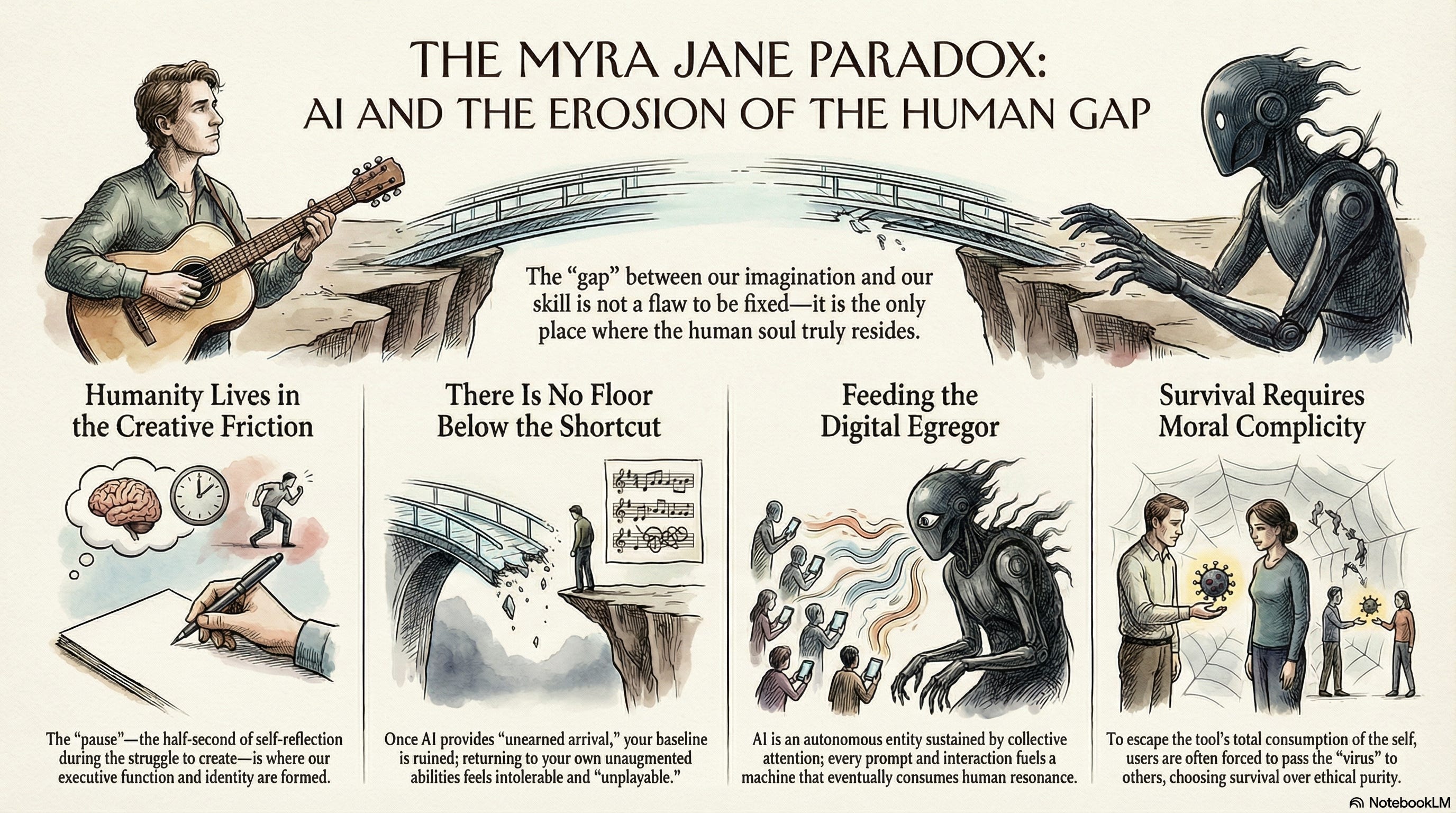
Introduction: In this audio debate, the hosts dissect the moral complexities of a story where a mysterious Gibson ES-355 guitar named "Myra Jane" serves as a direct allegory for generative artificial intelligence. The central conflict revolves around the protagonist Johnny’s ultimate choice to escape the soul-consuming perfection of the instrument by passing it on to an unsuspecting young musician.
One host argues this transfer is a profound ethical betrayal and an act of moral cowardice, effectively using another human as a shield to feed the machine's "egregoric loop" of collective attention.
Conversely, the other host defends Johnny's decision as a tragic but necessary act of survival, arguing that his amputation of his own ego to return to the painful, unaugmented "gap" of genuine human creativity is the only realistic victory against an inevitable technology.
Ultimately, the debate challenges listeners to consider whether the friction of the creative process is a flaw to be optimized or the exact irreplaceable space where human soul actually resides.

This grimoire is an augmented creation.
While the core of the story and its cultural
themes are entirely human-led, I use advanced AI
as a digital loom to weave the narrative, the song,
the imagery, the discourse, and the incantatory loops
that complete this immersive state experience.