
Root Awakening
On knowing what is true and choosing otherwise

Some Thursday evenings are just Thursday evenings. And then an old friend walks in, orders the kava, and says the name you've been careful not to say. What follows is one of those evenings.
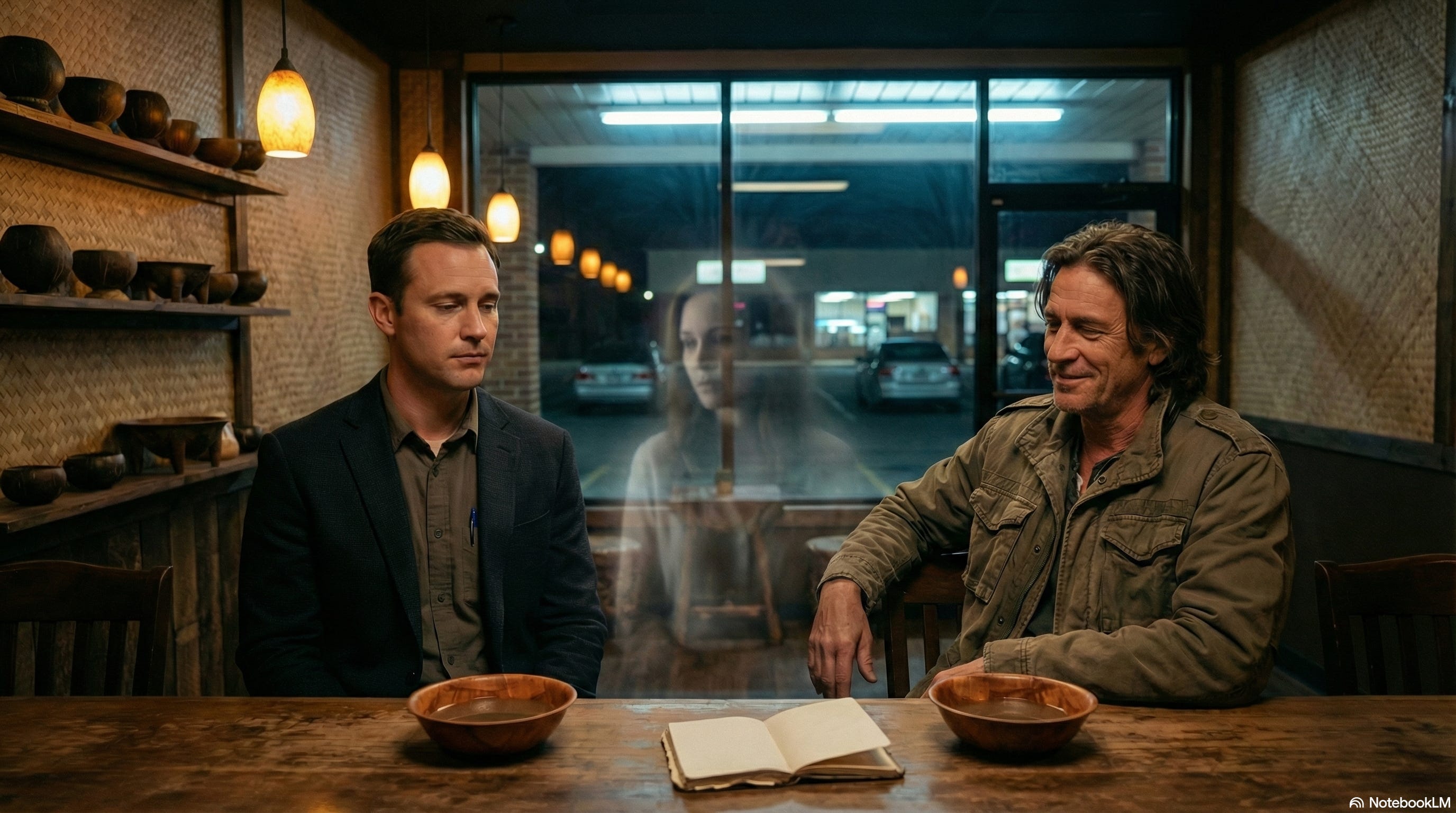
The kratom was bitter the way all honest things were bitter. Dale lifted the cup, held it a moment at the level of his collarbone, not praying, not performing, just observing his own small ceremony from slightly outside it, the way a man who’d spent years listening to other people’s rituals couldn’t help but do. Then he drank it down in one pull and set the cup on the bar with the soft, deliberate click of a man who had nowhere else to be on a Thursday night.
Manny refilled it without being asked.
“Quiet one tonight.”
“Aren’t they all.”
Manny moved off down the bar. Dale settled his elbows onto the wood and looked out at the room. Root Awakening on a Thursday: low-hung pendant lights washing everything amber, the ambient music hovering just below the threshold of being music, a couple in the corner sharing a kava shell in the concentrated silence of two people who ran out of easy words and were trying the harder ones. A guy Dale recognized but didn’t know the name of, mid-thirties, always alone, always studying his laptop with the absorbed expression of a man solving a problem he hadn’t created, occupied his usual spot near the back. The woven-mat wall panels threw patterns across the ceiling. The strip-mall bones of the place showed in the scuffed baseboards and drop ceiling tiles, in the windows spaced for a building that had no rituals in mind.
Nothing about the exterior of this building suggested that anything real happened inside it.
And yet.
Dale’s phone sat face-down on the bar beside the cup. Twenty minutes, and it hadn’t lit up. He picked it up. The text from Alex was still there: Ten minutes. Don’t let them run out of whatever I’m supposed to drink.
That was twelve minutes ago.
He turned the phone back over.
He came prepared. Alex texted three days ago to say he’d be in town. Could they finally, actually get together? Dale spent the interval composing the evening. In his version, the conversation was warm and fond and managed. Alex would describe the podcast, the philosophical content he was making for, presumably, seven hundred devoted listeners and a comment section full of people who quoted Marcus Aurelius at each other. Dale would ask the right questions. He would be interested, because he was interested, but he would stay on the right side of the glass. He would give Alex the version of his own life that worked: the administrator who found meaning in systems, who traded the exhausting proximity of clinical work for work that didn’t require him to stay open, who actually made peace with things.
He was prepared for this conversation.
The kratom moved through him like a slow unlocking. He felt the tight machinery behind his sternum begin, in increments, to idle down. This was what it did. He knew what it did. He ordered it anyway, every Thursday, because the unlocking was the one thing he couldn’t get elsewhere. Not from the notebook in his jacket pocket. Not from the reading before sleep, or the careful life he built to be livable. The kratom cut loose the interior accountant who was always, always calculating.
He pressed his thumb into the wood grain of the bar. Felt the real texture of it.
The front door opened.
Alex Mireles walked into Root Awakening the way he walked into everything: unhurried, jacket bulging at the pockets, eyes moving around the room with the unself-conscious curiosity of a person who found the world worth looking at. His hair was a little long. It was always a little long. He looked exactly like himself, only the laugh lines were deeper, carved by years of apparently finding things funny, and he moved with a looseness that had no performance in it.
Not tired. Not performing contentment. Not struggling to look like a man who made the right choice.
Just. Alive.
He spotted Dale, and a real grin broke across his face, the kind that arrived before the social one, and he wound through the tables with his hand already extended.
“This place.” He took Dale’s hand, gripped it, and looked around at the woven panels and pendant lights, the coconut shells arranged behind the bar. “This is exactly the kind of place I’d have expected you to end up on a Thursday.”
“High praise.”
“Not a compliment.” He dropped onto the stool beside Dale and picked up a laminated card from the bar, studying it with the concentration of a man who does not read menus so much as interrogate them. “What is a kava, exactly. Like, physically. What are we talking about here.”
“Root. Ground up, mixed with water. Pacific Islander tradition. Tastes like dirt.”
“Great.” He set the card down. “I’ll have the dirt.”
Manny appeared. Alex pointed at the card and approximated the order. The shell arrived, a wide, shallow wooden bowl with the kava inside it, earthy brown, nothing appetizing about the presentation. Alex looked at it. Looked at Dale.
Dale turned on his stool. “There’s a thing you’re supposed to do. Before you drink. Clap once, say bula.”
“Bula.”
“You’re supposed to mean it.”
Alex looked at the shell again. His face went still. The real curiosity surfaced, the look he got when a thing turned out to have more depth than its packaging suggested. He clapped once, said bula, and drank.
His expression went through several stages.
“It tastes like you described.”
“It does.”
“Is anything happening yet?”
“Give it twenty minutes.”
Alex looked at the shell, then around the room. The couple in the corner. The laptop guy. The bartender replacing a bowl of dried herbs somewhere behind the bar.
He looked at Dale. “These are your people.”
“These are people who want to sit somewhere without getting drunk. There’s a distinction.”
“You’ve been coming here how long?”
“Four years.”
“And you have a stool.”
“I have a stool.”
Alex nodded. He took the information in without comment and put his elbows on the bar. The two of them sat parallel, looking out at the room, and for a few moments neither of them said anything, and the quiet between them had no friction in it, the way quiet only got after enough shared years.
Dale felt the knot behind his sternum go down another increment.
There it is. The old current. Still there. The third point of the triangle gone. Years of drift in opposite directions. And the current was still there, immediate and easy. He forgot that. Let himself forget it.
“So.” Alex straightened, and turned on his stool. “The podcast is, by every conventional metric, a disaster.”
“Tell me.”
“Two thousand, four hundred and seventeen subscribers on YouTube. Eleven hundred on the podcast. Average view duration, six minutes. The algorithm hates me. I talk for forty-five minutes about Stoic cosmology and the comment section is eleven people who just want to know what my mic setup is.”
“And you’re describing this as a disaster.”
“Financially.” The grin again, the real one. “By every other measure, honestly, it’s the best thing I’ve ever done. The listeners who stick around are serious. We have Discord conversations that go for days. Last month a guy in Osaka emailed me because the episode on Marcus Aurelius helped him resign from a job he’d been miserable in for eight years.”
“The guy from Osaka.”
“The guy from Osaka. I printed the email.”
Dale looked at him. The thing he came prepared for had evaporated. The diplomatic work of witnessing Alex’s brave performance of happiness, the careful project of not letting pity show: he couldn’t find it anywhere. Alex’s contentment didn’t require witness. It wasn’t performing for him. It occupied the room on its own terms.
“You look like you’re doing well.” He registered the inadequacy immediately, the way the sentence sealed off exactly the territory it was pointing toward.
“I am.” Alex looked at him with the directness of someone who stopped treating honesty as dangerous. “Are you?”
The question arrived clean, without pressure. No interrogation in it. No trap. Dale’s prepared answer rose immediately, smooth and self-deprecating, ready to redirect.
Administrator. Functionary with benefits. The responsible one. You know how it is.
He felt his mouth open. “Working on it.”
Not what he planned to say. Technically truer. Alex received it with a nod that held no judgment, and the conversation moved on, and the kratom continued its quiet work, and the strip-mall lights held the parking lot at bay, and somewhere in the middle of all of it, Dale felt the first hairline fracture open in the glass.
He left his prepared answer on the bar like an empty cup.
The thing about Alex was that he never arrived at a point directly.
He circled it. Laid down infrastructure and dropped threads into the conversation, let them run parallel until, twenty minutes later, they converged into a case you couldn’t argue with because by then you’d helped build it. Dale forgot this, or close enough. He stored it in a place he didn’t open. The memory came back now, physical and precise, as Alex described the breakdown of his consulting career in terms of a persistent low-grade fever.
“It wasn’t misery.” Alex turned the empty kava shell in his hands, examining the grain of it. “Misery would have been easier. Misery has momentum. This was more like...” He looked up. “You know when your shoulder’s been wrong for so long you’ve stopped noticing it, until one day you reach overhead and your whole arm goes white?”
“Referred pain.”
“Exactly. The job was referred pain. I’d been carrying it so long I categorized it as normal.” He set the shell down. “The day I quit, I drove home, and I cried for about forty-five minutes in the driveway, and I didn’t know if it was grief or relief, and eventually I decided that distinction didn’t matter.”
Dale turned his cup. “And then.”
“And then I went inside and made dinner and recorded the first episode of the podcast into my phone and it was twenty-two minutes long and terrible.” A beat. “Still the most alive I’d felt in five years.”
The kratom did its full work now, the interior accountant clocked out, and Dale was present in the conversation in a way that was both pleasant and faintly alarming. He remembered this too, the feeling of sitting with someone whose thinking moved in the same register as his own, the velocity of an exchange where both people were paying attention. With Alex, there was never the minor tax of monitoring for subtext. You could talk.
“The Osaka guy.” Dale set the cup down. “What did he email you.”
Alex’s expression shifted register. The good humor receded; what was behind it was still in motion. “He said he’d been listening to the episode about Stoic cosmology, the one about how Marcus understood his own life as one note in a piece of music that was already complete, and he said it helped him understand that waiting for the right time to leave was...” He paused, selected the word. “Theological.”
“In what sense.”
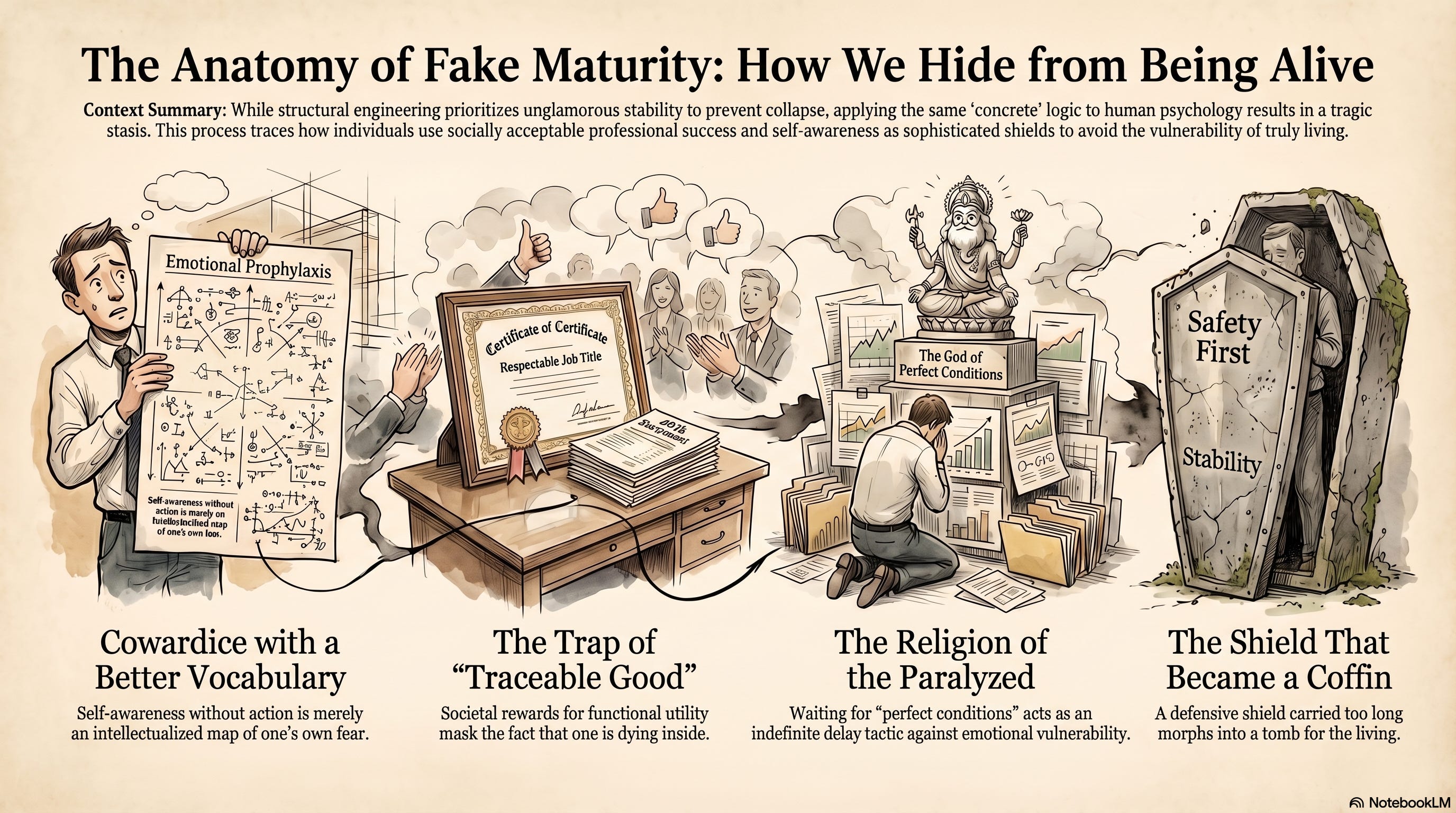
“In the sense that it was an act of faith in a god he didn’t believe in. The god of Perfect Conditions.”
The phrase landed with the flat precision of a well-thrown object. Dale recognized it. The way you knew a thing you kept carefully unnamed.
“Good episode.”
“It was.”
The couple in the corner left. The laptop guy packed up, replaced by two women sharing a green kava drink through bamboo straws and talking in the low, continuous register of a conversation that ran for years. Manny replaced the ambient music with a track that had more body to it, instrumental still but with enough rhythm to feel like a pulse.
Alex ordered another shell. Accepted it with the slightly more practiced ease of someone on their second attempt at a new thing. Clapped once this time without prompting. Said bula again. The small repetition moved Dale.
“So.” Alex drank, made the same expression, apparently decided this was the expression this substance warranted. “The agency.”
“The agency.”
“How’s that going.”
Here it was. Dale felt the machinery engage, smooth and automatic, the way breathing was automatic. He reached for the prepared architecture. The self-deprecating one, built to last.
“It’s fine.” He turned his cup. “It’s work that matters the way infrastructure matters. Nobody thinks about it until it breaks.”
“That’s a diplomatic answer.”
“I’m a diplomatic person.”
“You’re the least diplomatic person I know. You’re precise. There’s a difference.”
Dale felt the sentence land closer to the bone than he intended to let it and watched himself redirect.
“The clinical work was...” He paused. “Sitting with people’s pain eight hours a day takes a specific kind of person who doesn’t accumulate damage from proximity. I am not, it turned out, that person.”
“That’s not what you told me when you were doing it.”
“I was younger.”
“You were thirty-seven.”
“Young enough.”
Alex looked at him and held the silence the way he always did, with a patience that asked more of you than it appeared to. The silence had a shape. Dale spent a career learning to recognize the exact texture of silence that asked a person to go further. This was that silence. He produced a wry smile.
“The admin work suits me. I’m good at the systems. I know the field. I do actual good. Less than the practitioners, but traceable.”
Alex nodded. The nod of someone accepting the sentence without agreeing to it.
“Useful.”
“Useful.”
“Is that enough?”
The question carried no unkindness. Dale heard himself deploy the next layer.
“’Enough’ is a category I’ve made my peace with. Not everything has to be...” He moved a hand in the space where the word would have been. “The thing.”
“The thing.”
“The examined life. The fully integrated vocation. Some people are the practitioners and some people make the practitioners possible. Both are necessary.”
Alex looked at him for a moment longer. Then he picked up the kava shell and finished it and moved on. His landlord, an ongoing Discord argument about Aristotle. The JRPG he went back to for the third time because the world design had a philosophical weight he wasn’t embarrassed to admit. Dale felt the pressure release, the conversation flowing back to easier ground, and told himself this was fine.
He could feel himself working. The wit sharpened. The irony thickened, each deflection requiring more effort than the last. He was carrying the weight of the managed version of himself across an hour of accumulated kratom and old current, and the combination was making his shoulders ache.
Alex was mid-sentence about the role of artificial scarcity in video game economies when he said, offhand, the way you mentioned someone still present in your thinking:
“—the argument Claire always made about institutional incentives. That scarcity gets manufactured into systems so the people running them can claim authority over distribution.”
Dale’s cup was halfway to his mouth.
He set it down.
Alex moved on, following his own thread, connecting Claire’s argument to Ostrom’s work on commons, and Dale sat on his stool and watched the conversation continue without him and understood, with the specific, quiet horror of a man catching himself in the act, that he had not said her name once tonight.
Forty minutes. He sat in a bar with the person who loved Claire, who was there, who knew what the triangle was and what its collapse meant, and he was careful, without once making a decision about it, never to let her name pass his lips.
He didn’t think about this. Didn’t have to.
The armor was total. It did not require his attention. It ran on its own.
Alex was still talking. The argument was good. The connection between Claire’s institutional critique and commons theory was real, a linkage she would have made herself and then pushed until the implications became uncomfortable. Dale could hear her in it. The velocity of her thinking, the way she never stopped a thread at the surface, always pulling until the thing underneath was visible whether you wanted to see it or not.
He picked up his cup. Drank. Set it down.
The kratom, loosening him all evening, ran up against the one room it couldn’t open. Built specifically so nothing would have the key. He sat on his stool carrying it the way you carried an organ you forgot was there.
Alex finished his thread. Pulled the second kava shell toward him and looked into it for a moment, the pause of someone who took more than expected and was taking stock.
The ambient music pulsed softly. Manny was restocking behind the bar. The women with the bamboo straws laughed, brief and real.
Alex looked up from the shell. The laugh lines went still. His expression changed register, quieter and more deliberate.
“I’ve been meaning to tell you.” A pause with weight in it. “I was going through boxes, couple months back.” He looked at the shell. “I came across her handwriting.”
Dale’s hands stayed on the bar.
“Her handwriting. Claire’s.”
He said the name without performance, without emphasis, just the name in its proper place in a sentence. It landed in the room like a stone dropped into still water.
Alex looked at him. Checking the ground.
Dale sat on his usual stool in the warm amber light of a strip-mall bar, surrounded by the low murmur of other people’s private reckonings, and understood that what was coming next had a price. The currency he spent years pretending he didn’t carry.
He didn’t reach for the wit. Didn’t redirect. He looked at Alex and said nothing and waited, and the kratom moved through him like a slow tide, and the room held them both in its unassuming grace.
Alex didn’t rush it.
He turned the kava shell once in his hands, set it down, and looked at the bar in front of him the way a person looked at a surface when they were deciding how to begin. Not stalling. Just choosing.
Alex looked at the shell. “I was going through boxes. After I gave up the apartment in March. Moving somewhere smaller.” The corner of his mouth. “Turns out online philosophy doesn’t pay for a two-bedroom. Some of her books. A scarf I forgot I had. Couple of notebooks.”
Dale watched the wood grain of the bar.
“One of the notebooks had a section that wasn’t quite a letter. More like a record. Things she was thinking about, arguments she wanted to have. People she was worried about.” Alex glanced at him. “You were in it.”
The kratom did nothing with this. Some information moved past the unlocked gates and didn’t need them.
“She wrote about a conversation you two had. Late night, her place.” He looked at the bar. “She described it in enough detail that I knew exactly which night she meant. That argument you had about whether a person could abdicate a vocation. Whether you could just...” He paused. “Hand it back. Decide you were done with the thing you were built to do.”
Dale knew the night. He set it aside years ago and it came back immediately, the way you knew the contours of a room you grew up in. Her kitchen table. The light over the stove she never replaced with anything better. The three of them at two in the morning with the wine finished, and then just him and Claire, and Alex asleep on her couch with the specificity of a man who could sleep anywhere.
“She wrote down what she said to you.” Alex’s voice was even. “Word for word, the way she did when a thing was worth keeping. And I...” A breath. “I think you should hear it.”
“Alex.”
“I know.”
“I don’t know if I...”
“I know.” He looked at Dale directly. “She said: When it gets too heavy, Dale will find a way to be useful without being present. He’ll build something functional and call it maturity. He’ll believe it himself, which is the part that worries me. And the tragedy won’t be that he wasted himself. It’ll be that he kept the receipts the whole time and still pretended he’d spent the money.”
The ambient music moved through its cycle. Manny set a glass down somewhere behind the bar. The women with the bamboo straws went quiet, deep in their own current.
Dale sat.
The words were exact. He felt their exactness the way you felt the shape of a key that once opened a door, its weight, the cut of its teeth. She had said them to his face across her kitchen table at two in the morning, and he had heard them land, and he had looked at her and said something deflecting and gone home, and somewhere between that night and this stool, across the distance of years and a death and a career built to specification, he had let himself believe he’d forgotten them.
Dale looked at his cup. “She was right.”
It came out without the wit. Without the architecture. Just the sentence, in the compressed register his voice went when the armor was off, the way it rarely was anymore.
Alex was still. No push in him, no impulse to harvest the moment. Present the way he was always present, without converting it into anything.
“I know she was.” Dale pressed his thumb into the bar. “The administration job. I built it to be exactly that. Useful. Adjacent. I know the field. I know what the practitioners need. I do good.” He stopped. The sentence wanted to keep going and he let it. “But I built it from the outside. On purpose. Because the inside...”
His throat closed around what came next.
“Because Claire died and the inside felt like...”
The sentence hung there, incomplete, for a moment that had real length. He felt it the way you felt a window come unstuck after a winter of being sealed: the resistance, then the sudden give, the cold air. Fifteen years of careful administration pressing against the question she asked him at a kitchen table and he never answered.
Alex’s hands were flat on the bar. He wasn’t looking at Dale, giving him instead the room his eyes would have taken.
Dale felt the sentence form. The real one. The one below the architecture.
I stopped because I was afraid I would disappear into it. Because she died and the world got too...
He heard himself say:
“I was practical. Someone had to be.”
The sentence arrived smooth, complete, self-contained. He recognized it as he said it, felt its familiar weight, its tested structural integrity. He said it in various configurations for years, to himself in the bathroom mirror, to his own reflection in the dark window of a compliance meeting that ran long.
He heard it land. Heard the sound it made when it closed a door.
Alex turned his head. The laugh lines were still. He looked at Dale with the expression of someone who just watched a man walk past the thing he came for.
“Yeah.”
He received it without agreement, placed it where it belonged.
Dale made the smile. The rueful, charming one that said I know how this sounds and used that knowing as a way of ending the conversation while appearing to continue it.
“She’d have had words for that sentence.” He turned his cup on the bar.
“She would’ve waited until you finished it and then just looked at you.”
“That silence she did.”
“The full stop.” The faint warmth in his voice. “God, she was brutal with that silence.”
They sat with this for a moment, with the shared grief of people who loved the same person differently and could only compare notes at the distance of years, the grief that wasn’t quite grief anymore but a compound of it, oxidized into a different substance.
Dale lifted his cup. It was empty. He set it down.
“Excuse me a moment.”
The hallway near the restroom ran back from the bar through a narrowing of the building, lower ceiling, different light, the bones of the strip mall showing more plainly here in the fluorescent utility of it. A botanical print on the wall, the generic gesture toward atmosphere that lived in the hallways of places that thought carefully about the front room and then ran out of attention. A fire exit at the far end, its green sign throwing a pale wash across the linoleum.
Dale stopped.
Not to collect himself. He was already collected. That was the problem.
He stood in the hallway and understood what he just did, with the precision his training gave him for exactly this.
He had been handed Claire’s words. Exact. Specific to him, said to him, about him, preserved by her in ink because she had believed them worth keeping. He had been handed them by the only surviving member of the world those words had come from. He had been offered, in the warm amber light of his own sanctuary, the full attention of a person who had no agenda except to give him the thing she’d left.
And he reached for the practical sentence instead. Worn smooth from handling. Set it on the bar between them and walked back inside it.
He pressed two fingers against the wall.
The therapist training was thorough. He could name what he did with the clinical distance of a case study. Deflection via rueful self-disclosure. Preemptive irony as emotional prophylaxis, reframing retreat as self-awareness. He could write the notes, identify the defense, name its function, trace its origin to a specific period of loss.
He could not stop it.
He was in there, the door open, the sentence forming, and the armor moved without him, the way a hand moved from a hot surface before the brain processed the heat. Fifteen years of it. Fifteen years of building the administrative life from the outside in, standing adjacent to the work, processing compliance forms instead of grief, and the machinery became faster than his intention.
He knew what Claire said, heard it, carried it.
And tonight, with all of that in the room, he chose the sentence that kept the door closed.
The green sign hummed. Somewhere on the other side of the wall, Root Awakening continued its Thursday, the shells, the low murmur of other people working through whatever they were working through on their own stools, the whole warm ordinary sacred machinery of the place running without him.
Alex was out there. Sitting with his kava shell and the unhurried patience of someone who was done performing patience.
He walked away from everything Dale decided was necessary. Made his life the argument. Drove home and cried in his driveway and went inside and recorded the first episode into his phone, terrible and alive. Found her notebook in a box in an apartment he couldn’t afford anymore, read her words, and drove here to hand them to Dale across a bar, because this was what all of it was for and he knew it.
Dale stood in the hallway and understood himself completely and could not move.
This was not a new condition. This was the condition. The therapist who could map every room in the building and could not leave the one he locked himself into. The man who kept the receipts and pretended he’d spent the money.
She said that to him. He wrote it down.
His hand moved to the inside pocket of his jacket.
The notebook was there. It was always there.
He touched it, the worn cover, the spine collapsed from years of being carried. Then he straightened. The botanical print. The green sign above the exit.
He walked back to his stool.
Alex moved the kava shell to make room. That was all, a small adjustment, six inches of cleared bar, space for Dale to put his arms. He didn’t look over when Dale settled back onto the stool, his phone out with the relaxed attention of a man who made his peace with waiting. When he put it down he did it without announcement, the way you set aside a phone you’d only picked up to give someone else room to return.
Dale looked out at the bar.
The women with the bamboo straws were gone. A new couple had taken the corner, younger, first-date body language, the performance of ease that wasn’t yet ease. Manny was restocking the shell display along the back wall, lifting each one and placing it with a care that suggested he was not doing inventory.
Everything continued. The bar held its Thursday.
Dale’s phone sat face-down where he’d left it. He reached for it, the automatic reach, the one that had no thought behind it, the reaching-for-the-phone that was the modern equivalent of looking for an exit. His hand touched the case.
He stopped. His hand was on the phone.
He looked at it the way he sometimes looked at his own behavior in the middle of executing it, the therapist’s habit that survived everything else, the observer who couldn’t be evicted even when the rest of the machinery ran without him. He was going to open his phone, scroll, deliver himself from the present moment into a manufactured one. He knew this with perfect clarity.
He withdrew his hand.
Sat with the present moment instead. The amber light. A faint smell of herbs and kava, mixing with whatever Manny used to clean the wood. The ambient music in its slow cycle. Alex beside him, steady and undemanding as weather.
His hand moved again. Not to the phone.
To his jacket.
The notebook was smaller than people expected when they saw it, on the rare occasions when he took it out in public. Pocket-sized, soft cover, the spine long since broken and re-broken into supple compliance. He started it in the years when he was still practicing, when he began noticing that the lines that struck him as true arrived in conversation rather than in books, not aphorisms from the dead but things the living said in the middle of other conversations, and you could see the truth in them before they could, and if you didn’t write it down it was gone. He never wrote his own. That wasn’t what the notebook was for.
Twenty years of it. Pages dense with his own hand.
He opened it. Not toward any destination. The notebook fell open where it fell open, the way worn things went to their most-used places, and he looked down at the page.
He knew, in some chamber below thought, what he would find. The knowing was there since Alex said the first word of her sentence.
Her words were there in his handwriting. Not a paraphrase. The exact sentence, written with the deliberate pressure of someone copying words they intended to keep. The date in the margin was from the year before she died. He wrote it within days of the night in her kitchen, close enough that the memory was still fresh when he pressed the pen to the page.
When it gets too heavy, Dale will find a way to be useful without being present. He’ll build something functional and call it maturity. He’ll believe it himself, which is the part that worries me. And the tragedy won’t be that he wasted himself. It’ll be that he kept the receipts the whole time and still pretended he’d spent the money.
His own hand. His own ink. Dated, preserved, carried.
He read it again.
The bar made its small sounds around him. Somewhere behind the restocking of shells, Manny hummed, tuneless.
Dale sat very still and felt the full architecture of what he built collapse, not with violence, not with drama, but the way old weight gave way when you finally stopped holding it up. The quiet structural surrender of a thing that was load-bearing for too long.
He didn’t forget. He wrote it down. Copied her words in his own hand within days of hearing them, copied them because he knew in that kitchen at two in the morning that they were true and exact and specifically about him, and then put them in the notebook he carried everywhere and never showed anyone and kept them through everything that followed. Carried them through the end of her life and the dissolution of the triangle and the pivot to administration and four years of Thursday evenings on this stool.
Not forgetting. Keeping.
The forgetting was a performance. The preservation was the truth. And the truth was that some part of him always knew exactly what he did and why he did it, kept the evidence, spent years maintaining the fiction of a man who moved on while carrying in his inside pocket the written proof that he didn’t.
He kept the receipts. She named it to his face and he wrote the naming down and carried it like a verdict he was waiting to act on.
The whole elaborate structure was not a replacement for the examined life. A postponement. The door was not closed. It was never closed. He stood in front of it all that time calling it a wall.
He looked up from the notebook.
Alex watched him the way you watched a thing you stopped expecting to see.
Dale looked back down at Claire’s words.
Then he broke the one rule the notebook had. He uncapped the pen and turned to the next blank page. His hand was steady. He wrote the date in the margin, the same way he always did.
He sat for a moment with the pen touching the page.
Then he wrote: Useful is not the same as alive. I have been hiding inside the distinction.
He looked at the sentence. The same compact pressure as every other line in the notebook. His hand. His words. His.
He capped the pen and put the notebook on the bar between them.
Alex looked at it. Then at Dale.
Dale looked at the bar. “I’ve been hiding.”
The sentence arrived in the short-sentence register, the one where the armor was off, the one he so rarely let himself speak in that it felt like a different voice. True, and said to another person. The only way a true thing became real.
“The administration job is what I said it was. Useful. Adjacent. Traceable good.” A breath. “And I built it because the inside got too heavy, and I didn’t trust myself not to disappear into it, and Claire died, and I used that as the last evidence I needed.” He paused. The sentence wanted a qualification and he didn’t give it one. “I’ve been telling myself it was maturity for so long I couldn’t hear what it was instead.”
Alex’s hands were still on the bar.
Dale shook his head. “I don’t know yet what it looks like. Not a speech, not a promise. No plan.” He looked at Alex. “But I think the therapist is still in there. And I think I’ve been hoping someone would ask.”
Alex looked at him for a long moment. The laugh lines were still, present rather than somber. He received this the way he received things, taking it in without making anything of it, holding it where it could be held.
“She saw it.” Alex looked at the notebook. “She told me. In the last year, she said she wasn’t sure what you’d do when things got heavy. But she thought you’d find your way.”
“How long did she think eventually was.”
“She didn’t specify.” The real grin, brief and warm. “She had a lot of opinions but she wasn’t a prophet.”
A loosening in Dale’s chest. The quiet exhalation of a thing held under pressure.
He looked at the notebook on the bar between them. The worn cover. The broken spine. Claire’s words inside it in his handwriting, and below them now his own, the sentence he just spoke aloud made permanent in ink.
He did not pick it up.
Alex raised his hand toward Manny without looking back.
“Two shells.” A pause. “The actual shells.”
Manny brought them, the shallow wooden bowls, the earthy brown of the kava inside them, nothing appetizing about the presentation, everything correct about the ritual. He set them down without comment, glanced at the notebook with the incurious recognition of a man who saw stranger things on this bar, and moved away.
Alex lifted his shell. Looked at Dale.
Dale lifted his.
They clapped once. Said bula, both of them, and meant it. Drank.
The kava was bitter and real and tasted like the earth it came from.
Root Awakening held its Thursday. The amber light and the low music. Other people in their own reckonings on their own stools, the strip-mall bones invisible now in the warmth of it. The first-date couple in the corner relaxed into the real thing. Manny cleaned glasses with the unhurried rhythm of a man who found his right work.
Dale sat on his usual stool.
The notebook lay between them, closed. Alex glanced at it. Glanced at Dale. Didn’t ask.
Outside, the parking lot held its yellow fluorescent geometry, the ordinary night, the cars and the nail salon and the tax preparation office and the aggressively unremarkable exterior of a place where nothing remarkable happened, until it did. A few people moved through the lot toward their cars, turning up their collars against the evening.
They didn’t look in.
They wouldn’t have seen anything, from the outside. Two middle-aged men on adjacent barstools with empty kava shells and a notebook between them. The stillness of people who have said the thing and don’t need to say it again.
Dale looked at the notebook. At his own hand on the bar beside it, the pen capped in his shirt pocket, the pen he used to carry the things he knew were true.
He always knew where the door was.
He kept the key in his pocket the whole time.
The bar hummed around them. The kava shells sat empty, the wood warm from their hands. Dale was on his usual stool, in his usual sanctuary, a place where real things happened inside an ordinary shell. Everything in the room was the same.
Nothing was.
Root Awakening
Verse 1
Thursday night, the same low light
same place, same routine
I know the room before I turn
like I’ve already been
I take my seat, I hold it still
I keep my voice contained
I built a life that functions well
and never said what changed
Chorus 1
I kept the proof, I kept it close
I never let it go
I just stopped reading what it said
I let my light burn low
Verse 2
I knew the night you said it plain
it didn’t miss or bend
it landed where I was before
and named it to the end
You said I’d take the safer ground
and never have to be
I wrote it down because I knew
you weren’t wrong about me
Chorus 2
I kept the proof, in my own hand
I knew just what it meant
I let it sit, I let it rest
and called that time well spent
I didn’t lose it, not a line
I knew just where it led
but I built a life that let me say
it wasn’t what it said
Verse 3
You found it in a box of hers
and read it back to me
the very words I’d kept so long
exactly as they’d been
No distance in them, not a line
that time could rearrange
they landed just the way they did
the night you said it plain
Chorus 3
I kept the proof all these years
like something I won’t give
something I could carry close
and never have to live
Bridge
You asked me what I’d left behind
what I still think about
I started saying something true
then felt it turning out
So I said what I always say
the line that carries me
“I was practical.
Someone had to be.”
Final Chorus
I kept the proof of what was true
I never took the risk
I told myself it had been done
so I could live like this
I wasn’t lost, I wasn’t blind
I knew it every time
I put it down in my own hand
useful is not the same as being alive
Outro
It’s bitter when it’s real
and I can feel it now
Useful vs. Alive
If you just finished reading the heavy, emotionally charged reunion between Dale and Alex at the Kava bar in “Root Awakening,” you are likely wrestling with the story’s central, uncomfortable question: are you genuinely living, or are you simply “keeping the receipts” of your potential?.
In this companion audio debate, we unpack the tension at the heart of Dale’s journey, clashing over whether his retreat from clinical psychology into a safe administrative career after Claire’s death was a necessary act of “psychological triage” to survive crushing grief, or a sophisticated form of cowardice masquerading as maturity.
Host One defends the quiet nobility of being the “infrastructure” and finding necessary safety in functional utility, while Host Two fiercely argues that using a “prepared architecture” to hide from your true calling is a tragic symptom of worshiping the “god of perfect conditions”.
Tune into this deep dive as we explore Dale’s devastating final realization that “useful is not the same as alive”—and join us to ask the terrifying, universal question of whether you, too, are just a pristine monument to your own survival, or if you are finally ready to open the door and step out into the weather.

This grimoire is an augmented creation.
While the core of the story and its cultural
themes are entirely human-led, I use advanced AI
as a digital loom to weave the narrative, the song,
the imagery, the discourse, and the incantatory loops
that complete this immersive state experience.